
Breaking Down Silos: Navigating the Intersection of Environmental and Social risks for Investors
11 March 2026 - Environmental and social risks are compounding across economies and portfolios, yet most risk frameworks assess them in isolation. This report provides a practical, systems-based approach to help investors understand how these interconnected risks amplify financial exposure – particularly in high-impact sectors like agrifood – and outlines actionable levers to build resilience, reduce volatility and support long-term development.
Download the report
Watch the launch webinar, with lead author of the report, Trisha Mani and Head of the Investment Leaders Group, Elliot Cyriax.
About
Environmental and social risks are increasingly interconnected, creating compounding and financially material impacts across value chains, geographies and portfolios. Yet most risk frameworks assess these factors in isolation, underestimating how combined shocks can amplify volatility, undermine diversification and affect long-term returns.
These risks are particularly visible in global agrifood systems, which generate nearly 30% of global emissions but attract only 7% of climate investment. When climate shocks hit socially vulnerable regions, disruptions cascade through supply chains – driving credit defaults, asset impairments and food price volatility. What begins as a local environmental event can quickly become a systemic financial risk.
This report introduces a practical, systems-based framework to help investors assess how climate and social risks compound across geographic scale, value chains and socio-demographic vulnerabilities. Building on the Taskforce on Inequality and Social-related Financial Disclosures (TISFD), it translates emerging thinking into actionable guidance for investment decision-making.
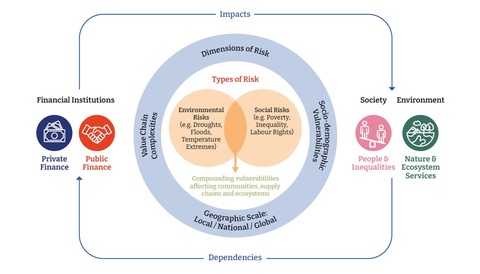
For investors, this translates into key challenges:
Intersecting climate and social risks can lead to underestimated downside risks, as probability, severity and persistence of losses can vary depending on underlying social vulnerabilities.
Traditional risk models overlook feedback loops that can increase correlation of losses across asset and geographies.
Environmental and social linkages operate across time horizons, eroding long-term portfolio stability and returns.
However, the research also highlights opportunity: investments in adaptation and resilience, regenerative agriculture and resilient value chains can reduce volatility while strengthening long-term returns.
To mobilise capital effectively, the research outlines three priority levers for investors:
Value chain finance – supporting corporates to strengthen supply chain resilience.
Stewardship and active engagement – influencing corporate behaviour and public policy to address systemic risks.
Blended finance and catalytic capital – using public and philanthropic capital to de-risk transformative private investment.
The message is clear: siloed risk frameworks are no longer fit for purpose. Integrating environmental and social risk is essential not only for sustainable development, but for safeguarding long-term resilience.
Citing this report
University of Cambridge Institute for Sustainability Leadership (CISL). (2026). Breaking down silos: Navigating the intersection of environmental and social risks for investors. Cambridge Institute for Sustainability Leadership.