
Aligning business models with a nature positive economy: from theory to practice
14 April 2026 – The world faces a global nature crisis, which is impacting the real economy and its key actors including businesses, governments and financial institutions. The global economy must take account of nature, which underpins its resilience and long-term stability. This requires a transition to a nature positive economy and to new business models aligned with this goal.
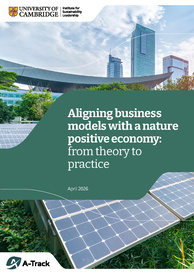
Aligning business models with a nature positive economy: from theory to practice
The new CISL report Aligning business models with a nature positive economy: from theory to practice is one of the key deliverables of the EU-funded A-Track project. The publication builds on the previous report Better business: Re-thinking business models for nature positive outcomes and presents several business model archetypes aligned with nature positive goal. The report also showcases relevant examples, case studies and methods that demonstrate the nature positive outcomes of these business models.
Business models that are aligned with nature positive goals form a crucial part of any economy-wide transition. Such models deliver ecological as well as financial value. Significant challenges exist to scaling up and integrating new business models at both the organisational and systemic level. This report sets practical examples of how businesses can adopt nature positive business models, embedding the delivery of better outcomes for nature within their core commercial structure.
With input from businesses and experts, this report identifies a series of enablers to exploit to transition to a nature positive economy in a strategic and proactive way. Businesses that adopt this approach will position themselves as the forefront of this new economy, helping to influence its shape as well as reaping its potential market rewards. Adopting such a proactive approach will require developing the right capacity-building within organisations, alongside re-thinking the organisational structures and governance.
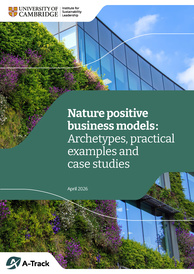
Nature positive business models: Archetypes, practical examples and case studies
The transition to a nature positive economy cannot be driven by businesses operating alone. The report provides the following recommendations to drive progress:
- Governments should provide clear and consistent policy and regulations that set nature goals.
- Collaboration between the public and private sectors will be essential to delivering these goals.
- Cross-sectoral and value chain collaboration can help to identify the opportunities, unlock innovation and align around the policy enablers needed in a given sector.
- The financial sector also has an important role to play, ensuring that capital is allocated to businesses able to minimise their impact on nature as well as those that can deliver nature restoration.
The A-Track project is helping to deliver many of these enablers through this publication and other initiatives across the public, private and voluntary sectors.
Get involved with this work
We are looking for businesses interested in the concepts presented in this report to work with us to refine, develop and test these ideas further. Businesses will benefit from working with CISL’s experts to understand how they might implement a business model shift while contributing to cutting edge research. Please contact Business&Nature@cisl.cam.ac.uk for further information, and sign up to receive A-Track project updates here.
Funding
This work has received funding from the European Union’s Horizon Europe research and innovation programme under grant agreement No 101082268 (A-Track project), as well as from the UK Research and Innovation (UKRI) under the UK Government’s Horizon Europe Guarantee and Switzerland’s State Secretariat for Education, Research and Innovation (SERI).
Citing this report
University of Cambridge Institute for Sustainability Leadership (CISL), Capitals Coalition, Oppla, UNEP-WCMC and WBCSD. (2026). Aligning business models with a nature positive economy: from theory to practice. A-Track. Cambridge, UK: University of Cambridge Institute for Sustainability Leadership