
skip to content

Cambridge Institute for Sustainability Leadership (CISL)

6 October 2025 – A primer by CISL and A-Track partners examines what financial institutions can already do – today – to scale action on nature

Download the report

About

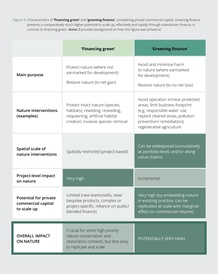
Nature (positive) finance is often narrowly perceived only as nature conservation finance, or ‘financing green’ with low financial returns, making it unsuitable and unattractive for private commercial capital at scale.

In this primer, we show how nature recovery finance or ‘greening finance’ to avoid and minimise harm to nature, as well as restoring nature to no net loss, can happen today and at scale with existing private commercial capital, through the everyday actions of financiers. The primer identifies one prerequisite step and four levers of change that financial institutions can use to achieve this shift in mainstream finance. These are illustrated with a series of practical, current, concrete examples from financial institutions and other actors. These examples showcase existing approaches to using these levers of change and highlight their potential for scale.
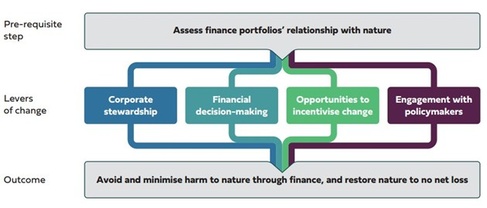
The cumulative positive effects from incremental improvements have the potential to be significant and widespread due to the potential of greening finance to scale up quickly. Our intention is that practitioners, equipped with this primer, will be inspired and empowered to act for nature today through mainstream finance practice, whether working in a bank, investment firm or insurance company.  

Purpose of this primer and intended audience

The primary audience for this primer is practitioners in financial institutions, with concrete examples from across the sector (banks, investors, insurers). It assumes no specific level of maturity on institutions’ journey toward nature-positive outcomes. The examples are not always best practice; they illustrate what institutions are doing now, rather than what they could or should do in theory. The primer also points to existing literature, case studies, and pilots where relevant. Our goal is that these real-world examples complement existing resources and inspire practitioners to act today. Policymakers, academics, and solution providers may also find the primer useful to inform their work in regulation, methods, capacity-building, and data provision.

Victoria Leggett, Co-chair, ILG working group and Senior Advisor to Union Bancaire Privée - " Investors have the power to shift capital away from activities that harm nature. Aligning portfolios with nature-positive outcomes safeguards long-term value and opens new opportunities for growth." 

Markus Müller, Managing Director, Chief Investment Officer Sustainability & Global Head of Chief Investment Office, Deutsche Bank - "Recognising borrower dependencies on clean water, healthy soils and biodiversity is part of responsible banking for clients’ long-term financial security.  Understanding and acting on nature risk is simply sound financial practice". 

Dr Nina Seega, Director, Centre for Sustainable Finance, CISL - "The cost of inaction on nature is rising — and our new report highlights existing tools already used by financial institutions, which can act as levers to reverse that trend. Wider take up of these tools is key to significantly reduce nature loss and build a more resilient global economy". Read her blog post on Forbes

Citing this report 

University of Cambridge Institute for Sustainability Leadership (CISL), Capitals Coalition, Tecnalia , Oppla, UNEP-WCMC, WBCSD. (2025). Scaling Finance for Nature: A primer on what financial institutions are doing today. A-Track. Cambridge, UK: Cambridge Institute for Sustainability Leadership.


Published: October 2025

Authors and acknowledgements

Lead Authors: Dr Corinne S Martin, Dr Jonathan Middleton, Dr Angela Small and Dr Nina Seega (CISL).

Contributors: Edmund Dickens (CISL); Guy Duke, Lenka Moore, Rosimeiry Portela (Capitals Coalition); Rafael Horn (Fraunhofer); Marco Bianchi (Tecnalia); Jonathan Porter, Matthew Brown (Oppla); Catarina Braga (UNEP-WCMC); Nadine McCormick (WBCSD). We also acknowledge the early contribution of Sara Taaffe and Rob Barker, while at CISL.

Acknowledgements

We are grateful to the following, whose insights on finance, nature, biodiversity and policy greatly supported the work from the outset:

  • Nature Steering Group (Banking Environment Initiative and Investment Leaders Group): Andre Jakobs, Ashleigh Sparrow, Sonny Dujin (ABN-AMRO); Mette Charles (Aon); Daniel Hochman, Jeremy Ng (Bridgewater); Markus Müller, Daniel Sacco (Deutsche Bank); Susannah Fitzherbert-Brockholes (HSBC); Eric Nietsch (Manulife Investment Management); Wataru Kawasaki (MUFG); Erwin Houbrechts (PGB); Alex Meraviglia, Rhona Turnbull (NatWest); Max Richardson (Rathbones); Laura Bosch Ferreté (Robeco); Etienne Butruille, Chris Vernon (Santander); Milena Lefèvre (State Street Global Advisors); Özgür Göker, Emma-Rose Smith, Victoria Leggett (UBP); Danielle Brassel (Zurich).
  • Nature and Insurance Steering Group (ClimateWise): Ben Howarth, Rebecca Lea (ABI); Lauren Clarke-Wiest (Aon); Thomas Viegas (Aviva); Suzanne Scatliffe (AXA XL); Chelsey Sprong (Beazley); Olivia Brindle (Canopius); Jonathan Kassian (Flood Re); Daniel Fairweather (Howden); Chris Suckling (Inigo Insurance); Denise Delaney, Helena Toro Walker, Natalia Estupinan Martinez, Rebecca Lewis (Liberty); Jack Longden (QBE); Jeffrey Manson (RenaissanceRe).
  • Expert Advisory Steering Group: Sara Taaffe (Church of England Pension Board); Julen González (Finance for Biodiversity Foundation); Nik Nicheperovich (GIST Impact); Jessica Smith (UNEP Finance Initiative); Laura Fisher (World Economic Forum).
  • CISL and A-Track colleagues: Martin Lok (Capitals Coalition); Anum Sheikh, Eliot Whittington, Elizabeth Clark, Felicity Alvey, Gwyn Rhodes, Harry Greenfield, Michaela Bruckner, Natalie Thompson, Sigrid Mueller, Tsvetelina Kuzmanova (CISL); Toby Roxburgh (ICAEW); Daniel Whitaker (IDEEA); Marina Isasa (Tecnalia); Rodrigo Cassola, Jorge Hinojosa (UNEP-WCMC); Andreas Gess (University of Stuttgart); Fernando Cirez, Alexandra Evans, Bruno Smets, Eline Vanuytrecht (VITO).
  • Participants in, and speakers (Monika Dyndo (Franklin Templeton) and Thomas Viegas (Aviva)) at the March 2025 A-Track-hosted ‘Accelerating Nature Finance’ session at the Nature Action Dialogues, convened by UNEP-WCMC.

Funding

This deliverable is part of a project (A-Track, https://a-track.info/) that has received funding from the European Union’s Horizon Europe research and innovation programme under grant agreement No 101082268, as well as from UK Research and Innovation (UKRI) and Switzerland’s State Secretariat for Education, Research and Innovation (SERI). The work also benefitted from a close collaboration with the Horizon Europe NATURANCE project (https://www.naturanceproject.eu/; grant agreement No 101060464). The work was co-funded by CISL’s Banking Environment Initiative, Investment Leaders Group and ClimateWise.

Disclaimer

The opinions expressed here are those of the authors and do not represent an official position of CISL or any of its individual business partners or clients.

Views and opinions expressed are those of the author(s) only and do not necessarily reflect those of the European Union or Research Executive Agency. Neither the European Union nor the granting authority can be held responsible for them. This deliverable is pending formal approval by the European Commission, hence the contents are subject to changes.

Copyright


Copyright © 2025 University of Cambridge Institute for Sustainability Leadership (CISL). Some rights reserved. The material featured in this publication (excluding photography) is licensed under the Creative Commons AttributionNonCommercial-ShareAlike 4.0 International Licence (CC BY-NC-SA 4.0).