
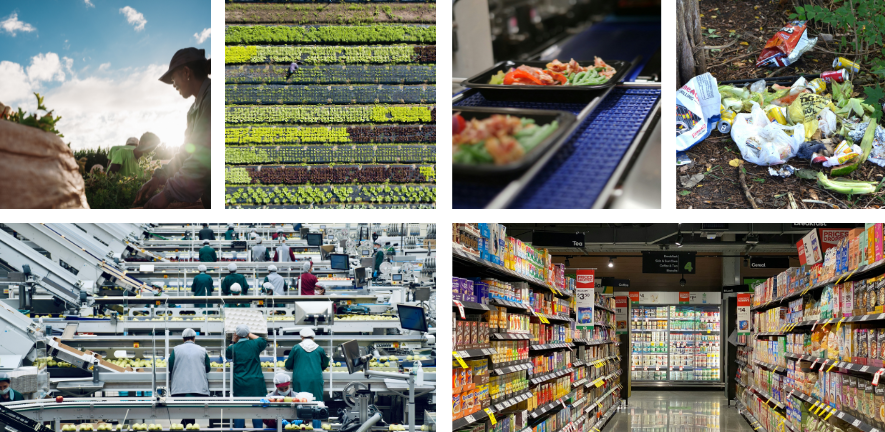
11 March 2026 - In this blog, Dr Tom Norton explores how accelerating climate, nature and geopolitical shocks are driving disruptive pressures across the food system. Although innovation is expanding, structural barriers continue to slow progress. The piece highlights cross-value-chain collaboration and responsible scaling as critical to resolving these barriers and creating better food systems. To make that possible, CISL is running a Leadership Lab that will bring together those with influence and intent to transform food systems for resilience and sustainability.
Context
Less than a year ago CISL published Renewable Food - a provocation to the food industry that disruption is coming, both from technology and sustainability related shocks, and that companies need to both build resilience into today’s value chains, and innovate towards a very different future food system.
In the last year, pressures on how food is produced, supplied and consumed intensified. Climate-shocks, water scarcity and biodiversity loss disrupted harvests and inflated prices across the system. At the same time, geopolitical tensions and trade barriers exposed supply chain instability, causing strategic food-security concerns for companies and governments alike. Alongside these disruptions, public debate around diet, well-being and ultra-processed foods sharpened, prompting regulators to scrutinise how food is produced, marketed and consumed. The outcome of these mounting pressures is a food system that recognises the need to change to ensure the system can survive and deliver for a growing population.
Against this backdrop, interest in solutions also grew. From regenerative approaches to restore soils, cut emissions, and build resilience, to new food technologies that require less land or resources, innovation is providing pathways for the sector to evolve. Yet parts of the sector remain invested in the status quo, slowing the uptake of new approaches, and storing up problems for companies, investors and societies later. Momentum may feel muted, but we remain poised at a tipping point. As risks amplify and pressure to change increases, new technologies with expanding capabilities and falling costs will interact with market forces to set the stage for a wave of food system innovation. But how can companies prepare themselves to navigate and thrive in a new food system?
Innovation
The challenges are well known: climate impacts, nature loss, and rising volatility are already shaping how we grow, trade, and consume food. Responses across the value chain, including soil health, crop resilience, supply chain, and consumer behaviour speak to the mounting momentum. The most promising opportunities are those that deliver multiple positive impacts - improving resilience, cutting emissions, improving livelihoods - and offer more to consumers. Yet while promising solutions are growing in number many are stalling, unable to break through the structural barriers that preserve the current system. The challenge is not a shortage of ideas, but selecting the most promising and addressing barriers to scaling these.
Many solutions struggle to attract investment, integrate into existing supply chains, or compete against entrenched business models. Others face regulatory uncertainty or lack the cross-sector collaboration needed to move from niche to norm. For now, food systems maintain structural incentives towards cost-optimisation, efficiency, and uniformity over long-term resilience. Powerful vested interests lobby against change, from restrictions on how plant-based products are labelled, to efforts to limit food tech around alternative proteins. Barriers also exist in public discourse, where narratives portray conventional farming as natural, and tech-based alternatives as risky.
Such friction, driven by commercial pressures, creates additional barriers. Farmers are encouraged to adopt organic and regenerative practices, but bear the transition costs and risks, incentivising some to pivot towards cash crops. Those that do transition may find themselves required by some retailers to package their sustainable produce in plastic packaging. These contradictions indicate shared barriers that no single organisation can overcome alone, and why collaboration across the value chain is vital to scale innovations.
Responsible scaling
Critically, innovation must scale responsibly so that the broader food system transformation is fair, trusted, and socially legitimate. A belief that a small set of companies are capturing disproportionate value while others bear the risk, as is often the case with palm oil and cocoa, fuels public distrust and cynicism. Responsible scaling requires more than technological breakthroughs that curb emissions. There must be fair competition and the equitable distribution of risk and reward across value chains where innovations create commercial, natural, and social capital, such as how Nestlé and General Mills co-fund transition costs for farmers.
CISL’s Food Systems Innovation Lab: Transforming Food Systems for Resilience and Sustainability
The food system is at a tipping point and change is coming. Our ability to turn innovation into scalable, systemic change and collective action will determine the shape and speed of the change. To help accelerate this thinking, our upcoming Leadership Lab will bring together leaders from across the food system working to drive meaningful change. The programme is designed to identify and unpack the barriers to progress and the collective responses that will enable the food system to scale responsibly, and build resilience across agriculture, supply chains, and markets.
The Lab will help participants pinpoint the shared barriers and structural challenges holding back innovation, from investment gaps to supply-chain constraints, and explore how coordinated action can unlock new opportunities and trigger multiplier effects. Through facilitated sessions we will develop ideas that participants can apply directly in their own organisations and value chains, and identify where pre-competitive collaboration can deliver greater impact at lower cost.
The transformation of our food system will not come from isolated breakthroughs or individual corporate commitments. Change will come from aligning incentives and scaling innovation in ways that strengthen resilience for everyone. Breaking the structural barriers obstructing progress requires collaboration across the value chain, shared risk, and shared benefit. The Lab exists to make that possible, bringing together those with influence and intent to reshape sustainable food systems.
CISL's Food Systems Innovation Lab: Transforming Food Systems for Resilience and Sustainability is a 2-day residential programme in Cambridge, UK in the second half of 2026. Find out more. If you have any questions about this Lab, please contact the team.