How do we rebuild confidence in the future - and in our collective ability to shape it? How do we reconnect economic growth with social progress, fairness, and stability? And how do we harness innovation without widening inequality or navigate political tensions without retreating from cooperation?
Responses to these questions demands new thinking - ideas that challenge assumptions, acknowledge what isn’t working and offer credible paths forward for business, finance and government.
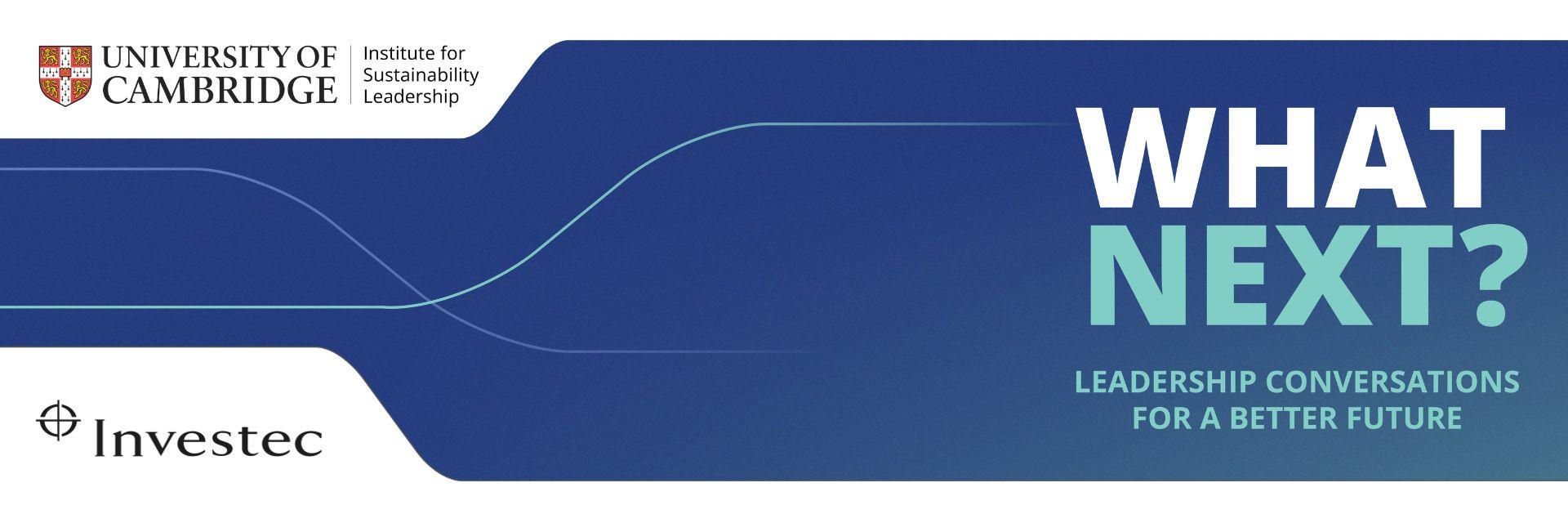
That’s the focus of our new podcast series, hosted by CISL CEO Lindsay Hooper, and Investec Chief Strategy & Sustainability Officer Marc Kahn.
You’ll hear from leaders, innovators and critical thinkers who are grappling with the toughest challenges of our time - and bringing forward important new thinking and practical action. From industrial transformation and AI to philanthropy’s catalytic role, the voices of the next generation and the shifting geopolitics of power, we ask how today’s leaders can bridge divides, unlock innovation and steer economies toward long-term stability and opportunity.
Subscribe on: Apple I Spotify I Amazon I YouTube I Iono
Episodes
Bridging the trust gap: rebuilding legitimacy through place and community with Jacinta Koolmatrie and Professor Mike Kenny
Listen now: Apple I Spotify I Amazon I YouTube I Iono
Across many societies, trust between communities and institutions has fractured. People feel decisions are remote, economies no longer work for them, and institutions do not recognise their on-the-ground realities. In this episode, Lindsay Hooper and Marc Kahn explore how trust and legitimacy can be rebuilt through place-based, community-led approaches, and why listening only matters when institutions are prepared to change how power is exercised. Professor Mike Kenny examines how economic transition, geographical polarisation and centralised governance have weakened the relationship between citizens and the state, creating deep place-based grievances. Jacinta Koolmatrie provides a grounded perspective from Aboriginal communities, where trust in institutions often never existed in the first place, and explains why consultation fails when institutions are unwilling to relinquish control, slow down, and work with communities on their own terms.
Making the Transition Investable: Policy Certainty, Capital, and Coordination with Marina Grossi, Sang-Hyup Kim & Helena Norrman
Listen now: Apple I Spotify I Amazon I YouTube I Iono
In this episode of What Next? Helena Norrman describes what this looks like inside one of the hardest sectors to decarbonise – steel - including the reality of upfront capital investment, permitting and policy risk, and the mismatch between industrial timelines and market expectations. Marina Grossi argues that confidence is rebuilt through delivery, evidence of real world outcomes, and coalitions and coordination to make progress investable. Sang-Hyup Kim explains why transition policy now sits at the centre of industrial strategy, competitiveness and geopolitics, and how “mini multilateralism” and practical platforms (including carbon markets and hydrogen) can unlock scale even when global cooperation is strained.
Reclaiming the Future from the Algorithm with Vilas Dhar
Listen now: Apple I Spotify I Amazon I YouTube I Iono
In this episode of What Next? Lindsay Hooper and Marc Kahn explore how leaders can reclaim agency over the future of AI, ensuring it serves human progress rather than narrow commercial or political interests. Vilas Dhar argues that the real challenge is not whether AI will become uncontrollable (this is the realm of Sci-Fi), but whether societies can adapt quickly enough to its social, economic and cultural impacts.
Changing Minds, Changing Markets with Micheal Liebreich and Rory Sutherland
Listen now: Apple I Spotify I Amazon I YouTube I Iono
In this episode of What Next?, Lindsay Hooper and Marc Kahn explore why changing markets now requires changing minds. Michael Liebreich and Rory Sutherland bring together energy systems thinking and behavioural science to unpack why backlash has emerged, how misinformation and poor incentives undermine progress, and why leadership must shift from moral persuasion to practical delivery. They argue that loss of trust has been driven not only by political polarisation, but also by unrealistic narratives, absolutist thinking and the promotion of costly or ineffective solutions. The conversation highlights the importance of affordability, credibility and human behaviour in building momentum for the transition - and why pragmatic, market-shaping solutions matter more than ever.
Backing the Future: Can Philanthropy Drive Systemic Change? with Peter Bennett & Leslie Johnston
Listen now: Apple I Spotify I Amazon I YouTube I Iono
In this episode our hosts explore the role of philanthropy in shaping cleaner, fairer and more resilient economies. Philanthropy funds much of the world’s high-risk innovation, early-stage ideas and new economic thinking — often long before markets or governments are able to act.
Rewiring Finance for a better future with Sarah Kemmitt, Nina Seega and Jose Vinals
Listen now: Apple I Spotify I Amazon I YouTube I Iono
In this episode, Lindsay Hooper and Marc Kahn examine a critical question: what will it take to align global capital with a cleaner, fairer, more resilient global economy? At a time when sustainable finance momentum has slowed, the discussion looks beyond the ESG “hype cycle”, to the underlying barriers to progress – and the priorities for action now. The guests analyse why finance has struggled to back real-world transition at scale, and outline the shifts needed to connect capital to what should be a huge financing opportunity.
The New Fault Line: How U.S. Polarisation Is Reshaping Global Sustainability with Gillian Tett and Professor Bob Eccles
Listen now: Apple I Spotify I Amazon I YouTube I Iono
The U.S. has become the centre of a global sustainability fault line: it hosts the world’s most advanced innovation ecosystem and deepest pools of private capital—yet remains locked in intensifying political polarisation, regulatory rollbacks, and an anti-ESG backlash. These tensions are reshaping climate policy, capital flows, and global markets.To understand this moment, Lindsay Hooper and Marc Kahn speak with two globally respected interpreters of political economy and corporate purpose. Together they explore how the U.S. arrived here, how companies are responding on the ground, what this means for global action, and how leaders can navigate the fragmented landscape.
The Meaning Deficit and Why It Matters to Leadership with Sudhanshu Palsule, Richard Springer and Gillian Secrett
Listen now: Apple I Spotify I Amazon I YouTube I Iono
This episode examines the emerging “meaning deficit” – the collapse of coherence, trust and belonging that is driving anxiety, polarisation and disengagement across societies. Lindsay Hooper and Marc Kahn ask a blunt question: why are so many people struggling to find meaning, and what does that imply for leaders operating in fractured systems?
The Value of Values with Alison Taylor and Karen Wood
Listen now: Apple I Spotify I Amazon I YouTube I Iono
In an era of market pressure, political backlash, and accusations of “purpose-washing”, do corporate values still matter? Why isn’t making money legally enough? And in markets that reward short-term performance above all else, what does it take to uphold principles, integrity and trust? This episode explores how values are a strategic imperative - not a “nice to have” - in shaping decisions, culture and legitimacy. The discussion cuts through slogans and corporate virtue signalling, asking what real values look like in practice and how leaders navigate tension between principle, and market or political pressure.
The Tech Reckoning: Who Shapes the Next Economy? with Thomas Lingard
Listen now: Apple I Spotify I Amazon I YouTube I Iono
This episode looks at the power shifts created by AI and digital systems - asks where real agency still lies. The discussion probes how digital power is concentrating, why regulatory systems are struggling to keep pace, and what it would take to steer emerging technologies toward societal benefit rather than narrow commercial gain. Thomas highlights the leadership capacities that now matter most: ethical judgement, systems intelligence, and the confidence to question deterministic narratives about technology. The episode asks a central question: how do we build an economy where technology strengthens society - and who has the responsibility and agency to shape that path?
Powering Africa’s Future with Carlos Lopes & Jasandra Nyker
Listen now: Apple I Spotify I Amazon I YouTube I Iono
This episode examines Africa’s energy transition as both an economic strategy and a question of agency, featuring insights from Professor Carlos Lopes and investment leader Jasandra Nyker. They argue that while the world often views Africa through the narrow lens of risk, fragility, or aid dependency, the continent increasingly sees itself as a driver of innovation, industrialisation, and clean energy leadership. The energy transition, they contend, should not be framed as a moral obligation imposed from abroad but as a catalyst for productivity, competitiveness, and long-term prosperity.
AI Shaping the Future with Dominic Vergine
Listen now: Apple I Spotify I Amazon I YouTube I Iono
In this episode, hosts Lindsay Hooper and Marc Kahn speak with innovation and sustainability leader Dominic Vergine about how artificial intelligence can be directed toward solving the world’s hardest engineering and energy challenges rather than fuelling hype or waste. Drawing on two decades at the intersection of technology, engineering, and purpose - including building the sustainability function at ARM - Dominic offers a grounded perspective on where AI’s genuine value lies and why leadership judgment, not speed, will determine its legacy.
Young Divided and Under Pressure with Clover Hogan and Ravi Naidoo
Listen now: Apple I Spotify I Amazon I YouTube I Iono
For years, we’ve comforted ourselves with the idea that young people will “save the world.” But is that hope realistic - or an unfair projection? Many young people care deeply about climate, justice and inequality, yet face economic precarity, political disillusionment and shrinking civic space. How can youth today find real agency and meaningful work amid systemic barriers and concentrated power?
From Heavy Industry to Clean Growth with Faustine Delasalle and Katie Fergusson
Listen now: Iono I Apple I Spotify I Amazon I YouTube
This episode focuses on the industrial transition — how to decarbonise the “hard-to-abate” sectors that power modern economies, and how to sustainably mine the metals and minerals needed to build the clean energy infrastructure of the future. While technologies for low-carbon, resource efficient steel, cement, heavy transport and mining are advancing rapidly, deployment still lags behind what’s required. Policy signals remain inconsistent, investment is cautious, and supply chains face both physical and geopolitical constraints. The conversation examines what’s working, where momentum is building, and what kind of leadership will be needed to deliver scale and pace.