
Insurability as a resilience signal
18 March 2026 - ClimateWise has published a new briefing outlining how insurability is one of the earliest signals of whether assets, sectors, and entire economies can survive the accelerating impacts of physical climate risk.
Download the full briefing
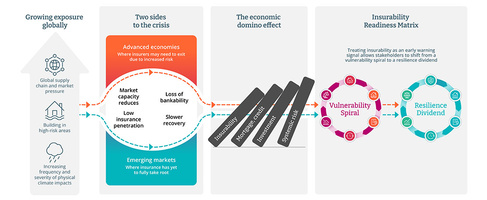
Insurability represents a threshold where insurance is available and affordable. When this signal begins to flicker, it indicates that the underlying risk may be outpacing our current capacity to manage it. If insurance is compelled to retreat, the domino effect is immediate: assets become unbankable, then uninvestable, triggering potential systemic economic, fiscal, and social risks.
The challenge of insurability
The briefing, titled “The canary in the coalmine: Insurability as a resilience signal,” warns that when insurance becomes unavailable or unaffordable, it triggers a "vulnerability spiral". This feeds into a domino effect that can quickly render assets unbankable and uninvestable, leading to systemic economic and social risks. To combat this, a shared language that enables the ecosystem to act to maintain and increase insurability is critical.
This systemic risk is already manifesting globally, with natural disasters causing US$318 billion in losses in 2024 - 25% above the ten-year average. Across the globe we are seeing:
- A widening protection gap: In 2024, more than half of total losses were uninsured, and this gap is expected to widen—rising by a further 25 per cent in 2025 and doubling by 2030 compared with 2023 levels.
- Fiscal strain: Governments are increasingly forced to backfill uninsured losses through debt and ad hoc aid, which is slower and less efficient than pre-arranged risk management.
- An inherent conflict: Despite clear risk signals, 57% of new homes in the US in 2023 and 11% of new homes built in the UK between 2022-2024 were constructed in high-risk areas.
There are important differences between insurance companies exiting high-risk markets in developed economies, and the low insurance penetration levels in emerging markets.
- Emerging Markets: In countries like Pakistan or the DRC, low insurance penetration (often below 1%) leads to economic recovery times four times longer than in high-penetration countries.
- Advanced Economies: In regions like California and the UK, there is a risk that insurers become compelled to exit high-risk markets, leading to mortgage and credit freezes.
But despite these different starting points to the crisis, the consequence – an economic domino effect where risks cascade across the economy – is a shared trap.
Citing this briefing
University of Cambridge Institute for Sustainability Leadership (CISL). (2026). The canary in the coalmine: Insurability as a resilience signal. Cambridge, UK: Cambridge Institute for Sustainability Leadership.
Read the Press Release about the briefing here
June 2026 - The ClimateWise Insurability Readiness Matrix A shared language for action
Uninsurability is not an inevitable outcome of climate change; it is a function of today's policy and investment decisions. As a result, there are a number of levers available to us in order to support insurability, ranging from improved modelling and data availability to risk-informed development.
Having first articulated the challenge of insurability in the briefing, ClimateWise has proceeded to publish an Insurability Readiness Matrix, a practical and collaborative tool that sets out to solve the problem, by driving the collective action needed to address the risks posed by insurability, this framework enables a shared language for (re)insurers, financial institutions, and policymakers to:
- Assess if assets or regions remain insurable under evolving climate scenarios
- Identify the specific levers required to maintain or improve insurability and bankability.