
Submitted by oo314 on Wed, 25/03/2026 - 09:42
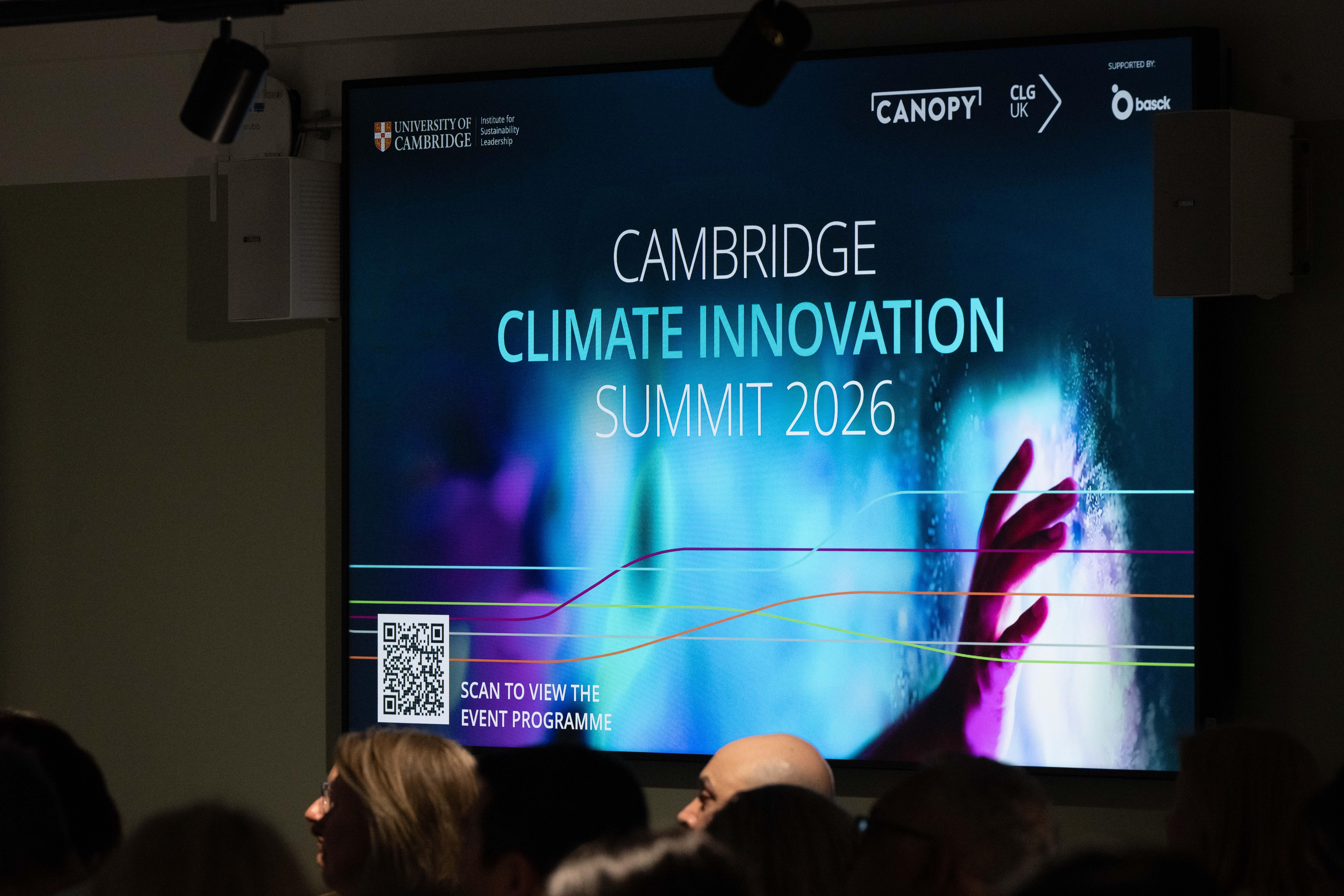
23 March 2026 - The Cambridge Climate Innovation Summit, hosted by the CISL at the Entopia Building brought together leaders from industry, investment, academia and high potential ventures to explore how climate innovation can move more rapidly from breakthrough to largescale market impact.
The Summit highlighted the scale of impact delivered through CISL’s innovation and accelerator activity. Over five years, CISL has supported more than 500 startups through 22 programmes and the Canopy community, helping ventures raise over £650m in funding, reach a combined valuation of £4.1bn and create more than 5,000 jobs. Together, these outcomes underline CISL’s role in translating innovation into large‑scale, market‑level impact.
Opening the Summit, Lindsay Hooper, CEO of CISL, reflected on how the innovation landscape has shifted from an era of ambitious pledges to a more constrained context where competitiveness and resilience are at stake. While many transition technologies now exist, progress is not yet happening at the required pace. She argued that accelerating change will depend on shaping markets, building coalitions across business, finance and policy, and changing the rules that govern investment and industry. From its position at the intersection of research, innovation, business and policy, Lindsay set out CISL’s role in helping scale solutions from proof of concept to industrial impact, with the goal of a new industrial economy where companies compete to win on sustainability.
Set against this backdrop, speakers noted that the economic case for clean technologies is strengthening, with analysis from the UK Climate Change Committee showing that the transition to net zero can be delivered cost-effectively while improving competitiveness, resilience and energy security.
Keynote speaker Nigel Topping, Chair of the UK Climate Change Committee and Co-Founder of Ambition Loop, reinforced the importance of this systems approach. Drawing on a career spanning manufacturing, business leadership and climate governance, he highlighted the critical role of universities in driving not just climate science, but also engineering, materials and applied innovation. When combined, these disciplines create vast economic opportunity. Topping emphasised the need to attract capital and cluster talent and described ‘ambition loops’ both hard feedback loops between policy and industry, and softer demand signals that unlock innovation and investment.
Reflecting on the wider context, James Cole, CISL’s Chief Innovation Officer, addressed the current backlash against ESG and sustainability narratives. He argued that sustainability has not stalled, but has diffused, becoming more specific, commercially relevant and embedded across industries and within companies. In this environment, innovation needs a clear ‘North Star,’ a strong evidence base and a relentless focus on building solutions that deliver tangible value, competitiveness and resilience.
A panel discussion on enabling innovation in industrial sectors followed, including Lamé Verre, Director for Net Zero, The Crown Estate, Neil Cameron, Partner, CoHead of Materials & Packaging, Emerald Technology Ventures, Ursula Woodburn, Director, CISL Europe and Alexandra French, Founder & CEO, Xampla, exploring what it takes to pull technologies through to scale. Speakers highlighted the importance of markets that value solutions, the need for cost parity and validated performance, policy alignment and the role of strategic early adopters in enabling growth. Challenges around credibility and green claims were also discussed, underlining the importance of independent validation and trusted partnerships as innovations move into mainstream markets.
The Summit also highlighted the strength of the Cambridge innovation ecosystem. Professor Sir John Aston, Pro Vice-Chancellor for Research and Innovation at the University of Cambridge, spoke about the city’s ethos of research that changes the world, and the importance of translating scientific excellence into real world impact through collaboration, investment and supportive infrastructure.
The day concluded with pitches from early-, growth- and scaleup-stage ventures across energy, materials, the built environment, water and supply chains, showcasing the breadth and maturity of solutions emerging from CISL’s innovation community. Collectively, the Summit reinforced a central message: innovation alone is not enough. Transformational impact depends on aligning markets, capital and policy and on ecosystems, like Cambridge, that can bring these forces together at pace.