
Restoring Human Progress: A Mission to Unlock Growth and Climate Action

4 December 2025 - Economic investment and meaningful action on climate and nature both depend on a shared foundation: belief in the future. New research shows that in every G7 country today, that belief is missing. To break the vicious cycle of malaise and shortsightedness, we need to restore human progress as the aspiration and expectation for our societies.
The Paradox of Rich-Country Despondency
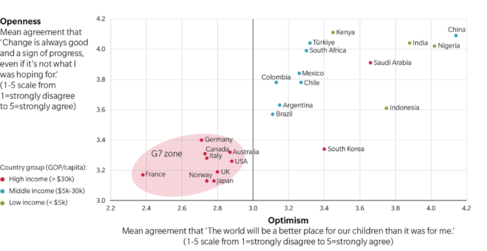
In the world today, the richer a country is, the more despondent its people tend to feel about the future. In G7 countries, most people believe the world will be worse for their children - a view far less common in emerging economies. Yet according to new research, paradoxically they are also less open to change.[i] (See figure.)
This combination is dispiriting: the world will worsen, yet we resist the actions needed to improve it.
Optimism and openness about the future, among the citizens of different countries
Source: Zero Ideas
When societies are this pessimistic, we live for today and don’t invest in tomorrow. We borrow from the future, regardless of whether we will be able to repay. We resist change, to protect ourselves from it. We extract and pollute without regard for it. We care about the future, but we don’t attend to it.
Our analysis shows that this despondency is driven not only by absolute wealth, but as much by a slowdown in long-term economic growth. For centuries, human progress - economic growth and increased energy use creating better health, wealth, security, and opportunity – has been the way of things. In most of the world, people still believe in this. In the G7, the public increasingly does not.
Overcoming this despondency is critical for economic growth in rich countries. Risk-taking, innovation, and investment all require belief in the future and openness to change. Without this, how do we respond to the transformational innovations of AI, quantum computing, and bio-digital convergence? The self-interest of business and mainstream political leaders in rebuilding citizens’ belief in the future is clear.
It is particularly critical for how we tackle climate change. Our despondency reinforces the framing of climate action as a conservation problem: we need to preserve what we have, by restricting what we do and hunkering down. But climate action is a transition problem: we need to invest in a new economy and create new markets.[ii]
To overcome the despondency in rich countries, we need to restore human progress as the aspiration and expectation for our societies, and not something we have left behind. We need it for our societal wellbeing, for ongoing economic growth, and for winning against climate change.
Three Principles for Restoring Human Progress
Restoring human progress sounds a tall order. It is. But it is also reassuringly familiar, not disarmingly new. In order to move forward, we need to get back to beliefs we have held before. It requires constructive collaboration between business and government - which our research shows is what citizens want to see.[iii]
Here are three guiding principles for making it happen:
Deliver meaningful gains
Growth in GDP and reduction in carbon emissions are not goals people can feel. In fact, while GDP growth correlates strongly with belief in the future over a generational timescale (20+ years), it is almost uncorrelated over just a few years. Instead, we need inspiring visions and tangible goals that people relate to, find worth striving for, and will be proud to see achieved.
That inspiration is never going to come from a financial number or a carbon number. But it could be about the future of our country’s food and farming, or towns and cities, or transport. When we set visions for sectors like these, we build in from the outset the relationships between different objectives - both positive reinforcements and conflicts - and their impacts on people’s lives.
Play to national strengths
The goal of restoring human progress is universal, but not uniform. Over a generation, citizens of G7 countries have seen their collective share of world GDP fall by a third, from two-thirds to less than half. That is still a big share, but the trend hurts; populism is rising in part because G7 citizens are fed up with losing. To build citizens’ confidence in and excitement about the future, we need to focus where our countries can thrive, lead, and win.
This is what China has been doing so effectively in solar, wind, batteries, and electric vehicles, building not only on their natural endowment of rare-earth minerals but also their unmatched manufacturing and learning curves. It’s what Germany could be doing in industrial electrification, heavy transport, and non-fossil chemicals; or France in nuclear energy and sustainable aviation; or Japan in high-efficiency and precision technologies.
Believe in better
Once we have goals that people want to achieve, people need to feel the progress that we are making towards those goals. Today, the sense is that we are not. GDP growth is historically low in most G7 countries, and the world is failing to meet its climate targets in a big way.
These widely broadcast headline statistics hide real progress. Diane Coyle has shown how the GDP metric misses out free digital services (and other advances), which have been the biggest focus of innovation and source of meaningful progress in the G7 in the past decades.[iv] And global carbon emissions statistics hide serious progress made in individual sectors and countries. In the UK, only 26% of people agree that ‘Britain’s policies to tackle climate change have made a meaningful difference to reducing Britain’s emissions’, and 41% disagree[v]-while in reality the country has cut its territorial emissions by half.[vi]
A Call for Leadership
To restore human progress, we need leadership: to envision progress that people can relate to and thrive in, and to harness the power of pride, belonging and being part of something bigger. Current disruptive forces make change inevitable; the opportunity is to create change for the better, not change at any cost.
It is common to invoke the spirit of the Apollo space program, but the Space Race itself wasn’t motivating; the vision that won it was. In the 1960s, few Americans saw reaching the moon before Russia as a priority problem for the government, and most doubted whether Apollo was worth the cost. [vii] Despite that, throughout the decade, most Americans gave the program their support.[viii] It drove their belief in shaping the future.
[i] Glynn, Simon; Whitehead, Claire (2025). Citizens’ despondency about the future is a disease of the G7. Zero Ideas. https://doi.org/10.70272/vfdv
[ii] Hooper, Lindsay; Gilding, Paul (2025). Competing in the Age of Disruption. Cambridge, UK: Cambridge Institute for Sustainability Leadership. https://www.cisl.cam.ac.uk/news-and-resources/publications/competing-age-disruption
[iii]Glynn, Simon (2024). Seeking Impact: Using theories of change to assess and guide corporate climate action, 19. Cambridge, UK: Centre for Climate Engagement at Hughes Hall, University of Cambridge. https://climatehughes.org/wp-content/uploads/2024/04/20240423-Seeking-Impact.pdf
[iv] Coyle, Diane (2025). The Urgent Need for Revolutionising Economic Statistics. Cambridge, UK: Bennett School of Public Policy. https://www.bennettschool.cam.ac.uk/blog/the-urgent-need-for-revolutionising-economic-statistics/
[v] More in Common (2025). Shattered Britain: Making sense of what Britons want in a country that feels broken. London, UK: More in Common. https://www.moreincommon.org.uk/our-work/research/shattered-britain/
[vi] Burnett, Nuala; Stewart, Iona; Hewitt, Thomas (2025). The UK’s Plans and Progress to Reach Net Zero by 2050. London, UK: House of Commons Library. https://commonslibrary.parliament.uk/research-briefings/cbp-9888/
[vii] Roger Launius, “Public opinion polls and perceptions of US human spaceflight,” Space Policy 19 (2003): 163–175, https://doi.org/10.1016/S0265-9646(03)00039-0
[viii] Launius, “Public opinion polls and perceptions of US human spaceflight.”